
AIM Centre Showcases the TRANSFORM Project at ATU Engineering Expo: From Smart Manufacturing to Secure Digital Transformation
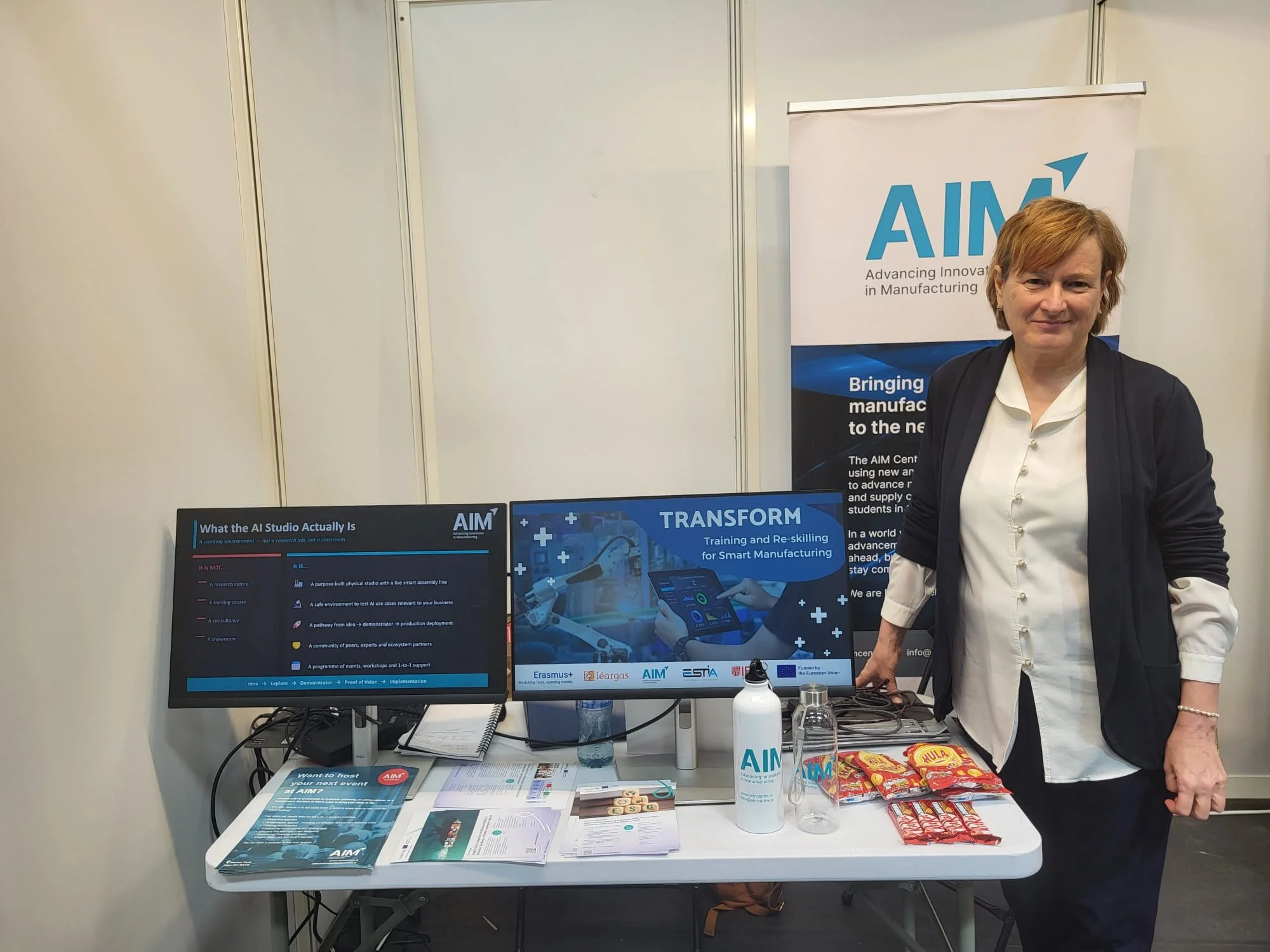
AIM Centre was delighted to participate in this year’s ATU Engineering Expo at Atlantic Technological University (ATU) Sligo, where our team engaged with students, educators, industry representatives and members of the wider community to showcase the latest developments in advanced manufacturing and artificial intelligence.
The event provided an excellent opportunity to showcase AIM Centre's wider portfolio of innovation initiatives. Alongside several European-funded projects, including the Erasmus+ TRANSFORM project, visitors learned about the upcoming National AI Studio for Manufacturing, which will support manufacturing SMEs in exploring practical AI solutions and accelerating their digital transformation.
TRANSFORM project is helping to address the growing need for digital and sustainability skills within manufacturing by bringing together partners from across Europe to develop innovative training resources and learning approaches that support the sector's green and digital transition.
One of the key themes presented through the TRANSFORM project is that digital transformation is not simply about adopting new technologies. It is about creating connected, resilient and secure manufacturing environments where people, processes and technology work together to support better business decisions. The project explores this journey through three interconnected themes: Smart Manufacturing, the Digital Thread, and Secure Digital Transformation.
From Smart Manufacturing to Shared Operational Truth
Smart manufacturing is generating unprecedented volumes of operational data through connected machines, industrial IoT, artificial intelligence, predictive maintenance and advanced automation. While these technologies create significant opportunities for improving productivity and sustainability, many manufacturers are discovering that collecting more data does not automatically lead to better decisions.
As organisations connect more production systems, existing organisational fragmentation often becomes more apparent. Planning, production, maintenance, quality and supply chain teams frequently work with different datasets, priorities and performance indicators. Without common governance and shared information, digital transformation can increase complexity rather than reduce it.
One of the key insights emerging from the TRANSFORM project is that successful digital transformation depends on creating a shared operational truth - where reliable, trusted information supports decision-making across the entire organisation.
Connecting IT and Operational Technology
Achieving this shared operational truth requires closer integration between Information Technology (IT) and Operational Technology (OT).
Traditionally, enterprise systems responsible for planning and business operations have evolved separately from factory-floor control systems. Today, however, manufacturers increasingly need these environments to work together to enable real-time visibility, predictive decision-making and operational agility.
Modern industrial frameworks such as ISA-95, OPC UA and MQTT Sparkplug are helping manufacturers establish common architectures and interoperable data models that allow production equipment, manufacturing execution systems and enterprise applications to communicate consistently. Rather than simply connecting systems, these approaches create a common operational language that improves collaboration between engineering, operations and business functions.
The Digital Thread: Connecting the Manufacturing Lifecycle
The next stage of the digital journey is the Digital Thread - a continuous flow of trusted information that connects design, engineering, production, maintenance and supply chain activities throughout the product lifecycle.
Rather than creating isolated dashboards or disconnected data repositories, the Digital Thread establishes a single source of truth that enables real-time visibility across the organisation. This allows manufacturers to respond more quickly to production issues, optimise maintenance activities, improve product quality and strengthen collaboration with suppliers and customers.
The real value of the Digital Thread lies not in generating more information, but in enabling faster, more informed and better coordinated decisions.
Secure Digital Transformation
As manufacturing systems become increasingly interconnected, cybersecurity becomes an essential business capability rather than simply an IT responsibility.
Operational Technology environments control physical assets, meaning that cyber incidents can directly affect production continuity, worker safety, product quality and supply chain resilience. Building secure digital manufacturing therefore requires more than technical controls. It also depends on governance, workforce capability, operational resilience and a culture of continuous improvement.
The TRANSFORM project promotes Secure Digital Transformation as the final stage of the digital journey, recognising that innovation can only deliver long-term value when connected operations remain trusted, resilient and secure.
For students and industry attendees alike, the Expo demonstrated how collaborative research, education and international partnerships are helping to shape the future of smart manufacturing, workforce development and industrial innovation. The discussions generated significant interest in how SMEs can adopt digital technologies in a practical and sustainable way while preparing for the next generation of intelligent manufacturing.
We would like to thank Atlantic Technological University for the invitation to participate and for hosting another excellent event that brings together industry, education and future talent. Events such as the ATU Engineering Expo provide an important platform for sharing knowledge, fostering collaboration and helping organisations navigate the opportunities and challenges of digital transformation.
This project is supported through Erasmus+ and contributes to strengthening digital and sustainability skills across Europe’s manufacturing sector.